What Does HCL on Your Prescription Really Mean? A Simple 2026 Guide
Have you ever looked at your prescription and noticed “HCL” written after a medicine name? Many people see it and wonder what it actually means. If you are confused, you are not alone.
In simple terms, HCL on your prescription means Hydrochloride, a form of medicine that helps the drug work better in your body. Doctors and pharmacists often add HCL to certain medicines to improve absorption and stability.
Understanding HCL on your prescription can help you feel more confident about the medicines you take. In this guide, I will explain the meaning, why doctors use it, examples, and how it affects your medication in easy language.
Quick Meaning of HCL on a Prescription
🟦 Quick Meaning Box
HCL = Hydrochloride
It means the medicine is combined with hydrochloric acid to create a salt form that helps the drug:
- Dissolve faster
- Absorb better in the body
- Stay stable for longer
So if you see “medicine name + HCL”, it simply refers to the chemical form of the drug, not a different medicine.
Example:
- Metformin HCL
- Diphenhydramine HCL
- Tramadol HCL
What Does HCL Mean in Medical Prescriptions?
In medical terms, HCL stands for Hydrochloride.
Pharmaceutical companies combine certain medicines with hydrochloric acid to form a hydrochloride salt. This process helps the medicine dissolve easily in your stomach.
Why is this important?
Your body absorbs medicines through fluids. If a drug dissolves quickly, it can enter the bloodstream more efficiently.
Doctors write HCL on your prescription so pharmacists know the exact chemical form of the medication.
Why Doctors Write HCL on Prescriptions
Doctors and pharmaceutical companies use HCL forms of medicine for several important reasons.
1. Better Absorption
The hydrochloride form dissolves quickly in stomach acid. This helps the body absorb the medicine faster.
2. Improved Stability
Some medicines break down easily. Adding hydrochloride makes them more stable during storage.
3. Accurate Dosage
Using a specific chemical form ensures patients receive the correct and consistent dose.
4. Easier Manufacturing
The hydrochloride form is easier for pharmaceutical companies to produce in tablets and capsules.
💡 Pro Tip:
If your prescription says “HCL”, it does not change how you take the medicine. Always follow your doctor’s dosage instructions.
Common Medicines That Use HCL
Many well-known medicines are written with HCL on prescriptions.
Examples include:
- Metformin HCL – used for diabetes
- Diphenhydramine HCL – used for allergies
- Tramadol HCL – used for pain relief
- Lidocaine HCL – used as a local anesthetic
- Sertraline HCL – used for depression
These medicines work the same way, but the hydrochloride form helps them dissolve and absorb better.
HCL vs Regular Medicine: What’s the Difference?
| Feature | Medicine Without HCL | Medicine With HCL |
|---|---|---|
| Chemical form | Base form | Hydrochloride salt form |
| Absorption | Slower in some cases | Faster absorption |
| Stability | Less stable | More stable |
| Prescription label | Only drug name | Drug name + HCL |
| Effectiveness | Same drug | Same drug, improved delivery |
👉 Important: Both forms contain the same active medicine. HCL only improves how the drug works in the body.
Real-Life Example of HCL on a Prescription
Let’s imagine you visit a doctor for allergies.
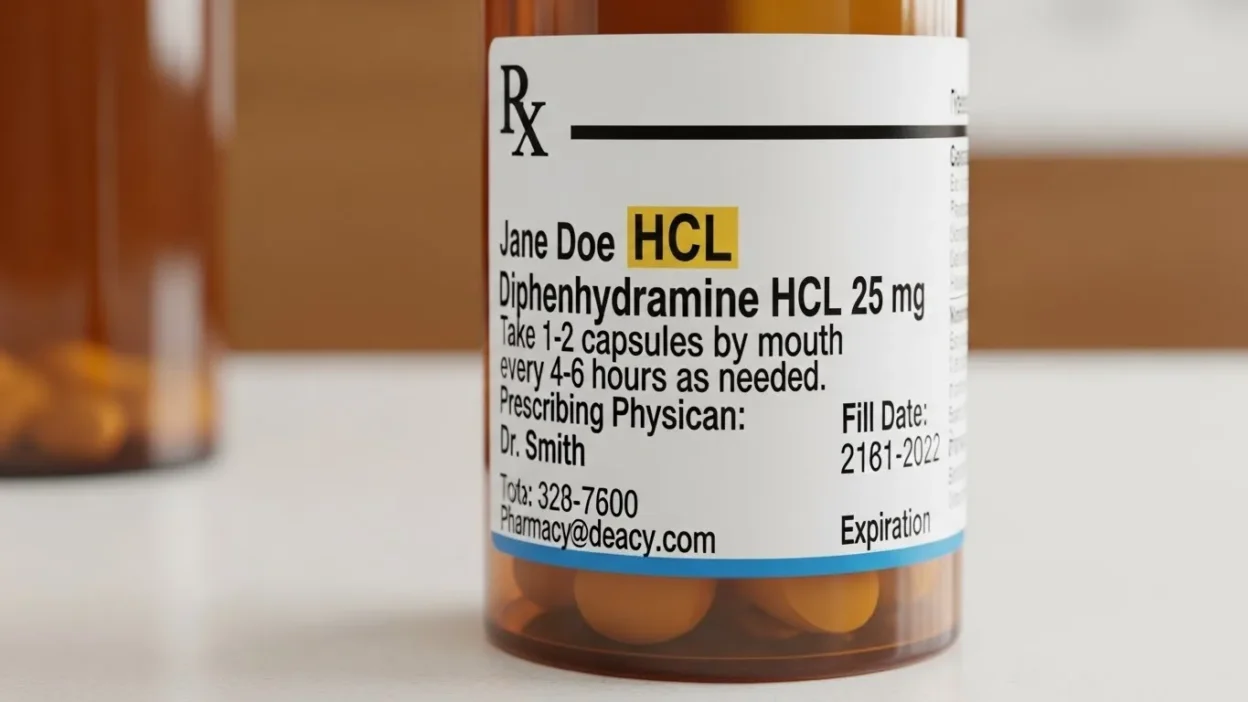
Your prescription may say:
Diphenhydramine HCL 25 mg
Here is what each part means:
- Diphenhydramine → the active drug
- HCL → hydrochloride form of the drug
- 25 mg → dosage strength
So the HCL simply describes the chemical form of the medicine, not a different medication.
Is HCL Safe in Medicines?
Yes, HCL forms of medicine are completely safe when prescribed by a doctor.
Pharmaceutical companies have used hydrochloride forms for decades because they:
- Improve drug absorption
- Maintain stability
- Allow accurate dosing
Once the medicine enters your body, the hydrochloride part separates and does not cause harm.
However, always follow your doctor’s instructions and never change medication without medical advice.
Similar Medical Terms You May See on Prescriptions
Sometimes prescriptions include other chemical forms besides HCL.
Similar Slang Words or Alternatives Table
| Term on Prescription | Meaning | Why It Is Used |
|---|---|---|
| HCL | Hydrochloride | Improves absorption |
| Sodium | Sodium salt form | Stabilizes medicine |
| Sulfate | Sulfate compound | Helps solubility |
| Phosphate | Phosphate salt | Enhances absorption |
| Acetate | Acetate form | Improves stability |
These terms help pharmacists identify the exact chemical structure of the medicine.
When Should You Ask Your Pharmacist About HCL?
Most of the time, you do not need to worry about HCL on a prescription. But you should ask your pharmacist if:
- The medicine name looks unfamiliar
- You are switching between brands
- You want to confirm dosage strength
- You have allergies to certain compounds
Pharmacists are trained to explain these details and make sure your medication is safe.
FAQs About HCL on Prescriptions
What does HCL stand for on a prescription?
HCL stands for Hydrochloride, which is a chemical form of a medicine that improves its absorption and stability in the body.
Is HCL a different medicine?
No. It is the same medicine in a hydrochloride form that helps the drug dissolve more easily.
Why do many medicines include HCL?
Pharmaceutical companies use HCL because it makes drugs more stable, easier to absorb, and more effective.
Is hydrochloride harmful in medicines?
No. Hydrochloride forms are safe and widely used in approved medications.
Can I take medicine without HCL instead?
Only if your doctor prescribes it. Some medicines work best in their hydrochloride form.
Conclusion ✅
Seeing HCL on a prescription might seem confusing at first, but now you know it simply means Hydrochloride, the salt form of your medicine that helps it work effectively.
Next time you pick up your prescription, you can confidently understand what HCL stands for and why it’s important for your health. Knowledge like this ensures you’re always informed about what you’re taking!